|
TREES |
|
|
|
|

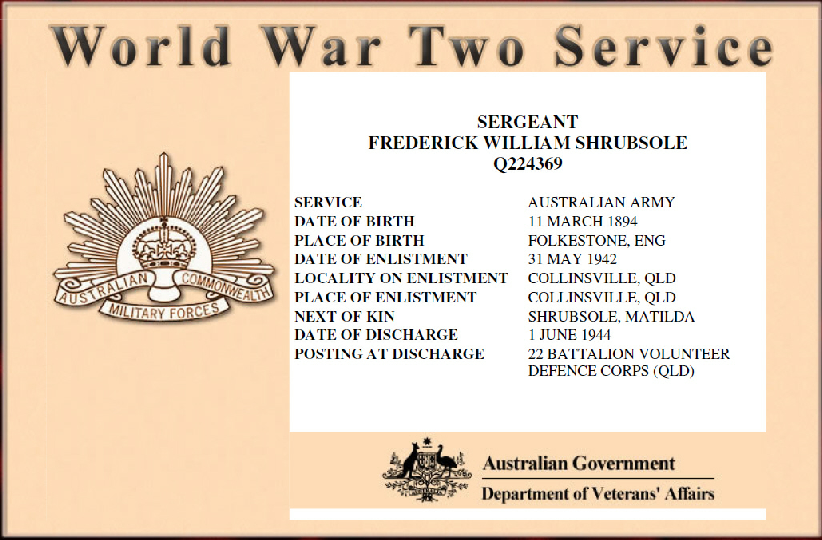
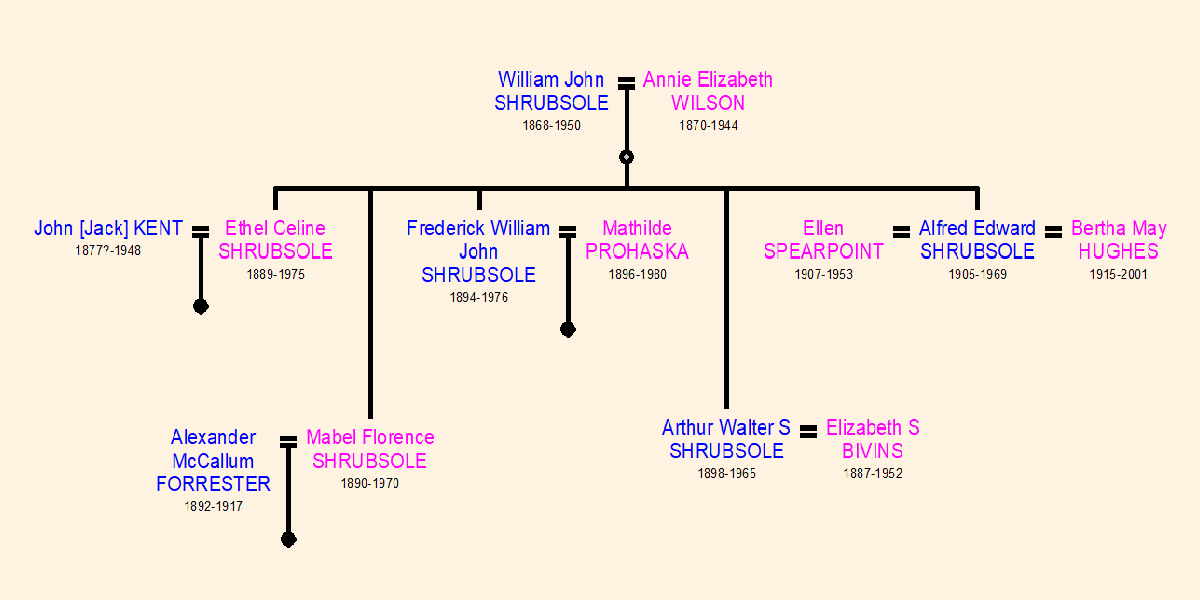
FREDERICK WILLIAM JOHN SHRUBSOLE
b 1894 Folkestone, Kent, England
d 1976 Collinsville, Queensland, Australia
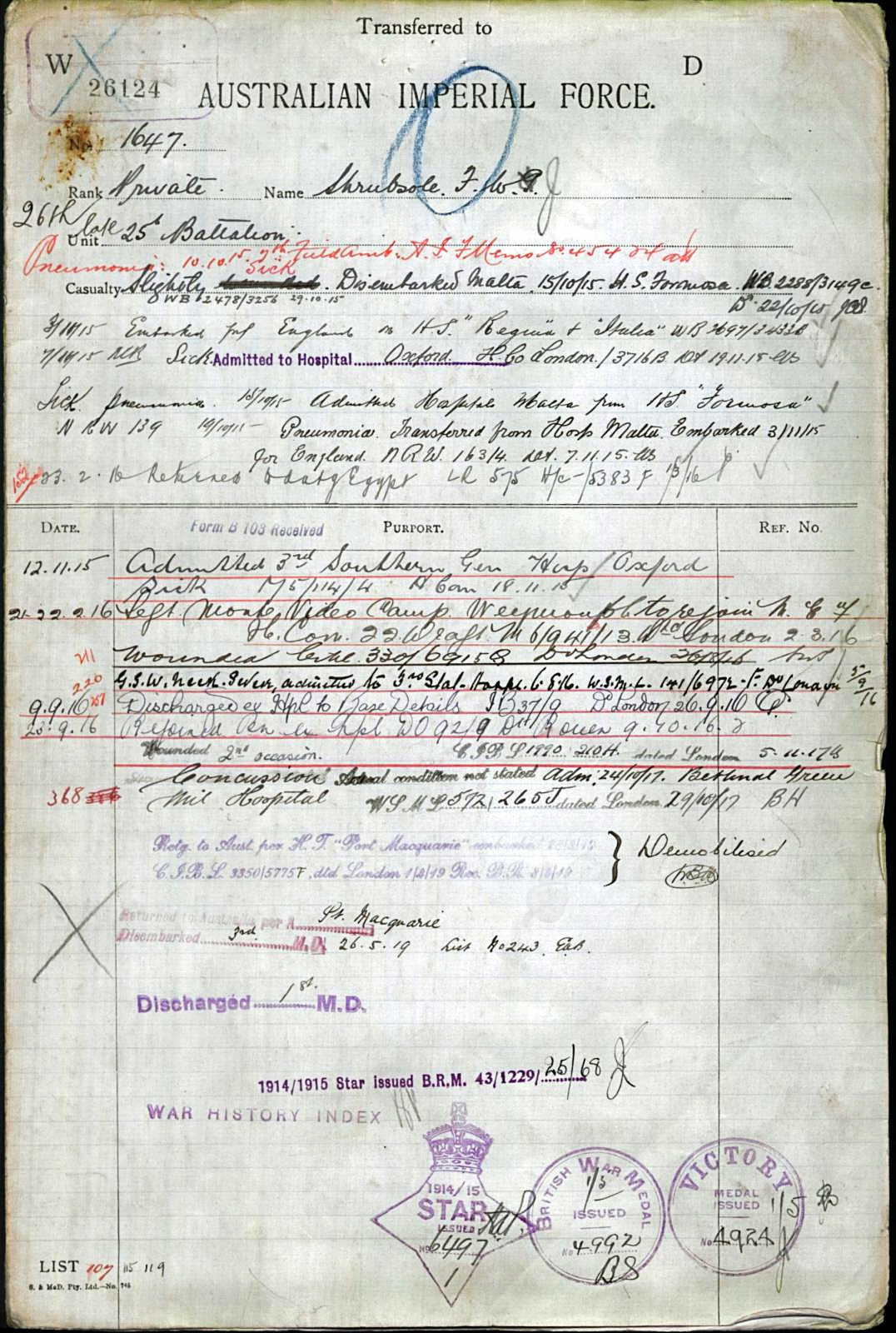
Australian Army 25th Battalion
The 25th Battalion was raised at Enoggera in Queensland in March 1915 as part of the 7th Brigade. Although predominantly composed of men recruited in Queensland, the battalion also included a small contingent of men from Darwin. The battalion left Australia in early July, trained in Egypt during August, and by early September was manning trenches at Gallipoli.
At Gallipoli the 7th Brigade reinforced the depleted New Zealand and Australian Division. It left the peninsular on 18 December 1915.
After further training in Egypt, the 25th Battalion proceeded to France. Landing on 19 March 1916, it was the first AIF battalion to arrive there. Now fighting as part of the 2nd Division, it took part in its first major battle at Pozières between 25 July and 7 August in the course of which it suffered 785 casualties. After a spell in a quieter sector of the front in Belgium, the 2nd Division came south in October to attack again in the Somme Valley. The 25th Battalion took part in two attacks to the east of Flers, both of which floundered in the mud.
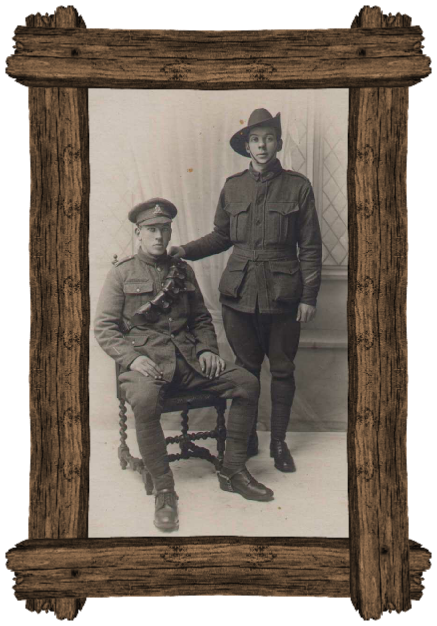
Frederick is the one standing in the uniform of the Australian Infantry whilst his brother Arthur, who is sitting, is in the uniform of the London Artillery. This photo was taken when on leave in 1916.
We have a lovely history of Frederick, who emigrated to Australia in 1912, written down by his daughter Valda, which gives us a brilliant snapshot of his life up to the end of the First World War, when he returned to Australia in March 1919.
Frederick was born in Folkestone, Kent, England, 11th March, 1894. He attended school at Horn Street State School, Cheriton, Folkestone, Kent. Started at age of 5 years, finished in 1908 aged 14 years. Worked: Charles Taylor (Chemist), Cheriton until June 1911; Army Camp canteen for three months, Farm outside London for approximately three months. Aged 17 sailed for Australia on/about 9th November, 1911 from Tilbury Docks, London, under Church Army Land Scheme, travelling with eight other 17 year old lads. Ports of call were Port Said, Aden, Colombo, Singapore, docking in Brisbane on 25th December, 1911. He was taken to a Government Institution for Christmas dinner (boiled potato in jacket, with corned beef, and plum pudding). He arrived with fourpence in his pocket and after dinner he wrote a letter home to England saying he'd arrived safely, and spent one penny on the stamp. He bought a packet of Capstan cigarettes for threepence, which left him broke. He was given a room Christmas night, and the following morning was given a packet of sandwiches and two shillings, and put on a train for Pomona. From here was picked up by a mail coach and taken to Kin-
After his leave he went to the Australian Detail Camp at Sutton Viny (?) in February, and detailed reinforcements sailed to Egypt to join up with his old 25th Battalion at Tal-
In July, 1916 entrained for Poziers where troops were regrouped as a Division in that district. The 2nd Division went into the line and attacked at Poziers. Because wire entanglements were not cut the men were slaughtered and beaten back to their own line. With English Artillery support they were reorganized and attacked five days later and took all positions.
Fred was a battalion runner at the time and remained as such until the end of the War. He was wounded in the neck by a German shell. Being walking wounded he had to take three German privates and one officer back to "Sausage Gully". The German officer who was previously a waiter in London, called up into the German Army, spoke excellent English. One prisoner was blinded, the other two led him. The German Officer refused to go the way Fred was leading them, saying that the Germans had a periscope and could see the English soldiers, and would be able to "pick them off". He then led his own three men and Fred to safety to "Sausage Gully". After handing the prisoners over to the provost, he had his wound dressed at the aid post, mounted a horse ambulance and was taken to a little village where he had a piece of steel removed from near the jugular vein. He was in that English hospital for about two weeks.
Frederick also served in the Australian Home Defence Corps during WWII from 1942-